Standard Penetration Test, SPT
SPT is a common in-situ test used to estimate soil resistance and collect disturbed soil samples.
Overview
The Standard Penetration Test is performed during drilling by driving a split-spoon sampler into the soil using repeated hammer blows. The test provides a field blow count, commonly called the SPT N-value, which gives an empirical indication of soil resistance at the test depth.
SPT is widely used because it is simple, economical, and supported by many empirical correlations. In practice, SPT results are often used for soil classification, preliminary assessment of soil density or consistency, foundation design, settlement evaluation, and liquefaction screening.
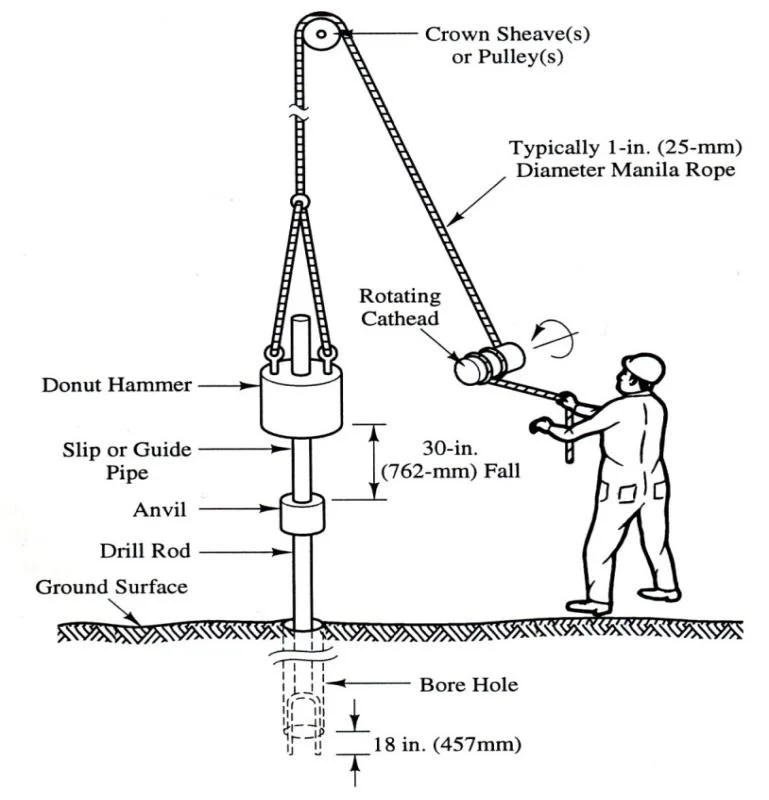
Test Procedure
During the test, the sampler is driven into the soil over a total penetration of 450 mm. This penetration is usually divided into three intervals of 150 mm each.
The first 150 mm interval is considered the seating drive. This part helps seat the sampler below the bottom of the borehole and is not included in the reported SPT N-value.
The SPT N-value is calculated from the number of blows required for the second and third 150 mm intervals:
where is the blow count for the second 150 mm interval, and is the blow count for the third 150 mm interval.
Interpretation of SPT N-Value
The raw SPT N-value provides a general indication of soil resistance. In granular soils, higher N-values usually indicate denser material. In cohesive soils, higher N-values may suggest stiffer consistency, but the relationship is less direct because clay behavior depends on sensitivity, plasticity, structure, and disturbance during sampling.
For this reason, SPT results should not be treated as direct measurements of soil strength or stiffness. They are empirical field indicators that require engineering judgment and, where available, support from laboratory testing and local experience.
Factors Affecting SPT Results
The measured N-value depends on both soil resistance and field testing conditions. Several factors can influence the recorded blow count, including hammer energy, rod length, borehole diameter, sampler type, drilling method, groundwater condition, and overburden stress.
Because of these effects, raw N-values are commonly corrected before they are used in engineering correlations. A common correction normalizes the blow count to a hammer energy ratio of 60%, producing N60N60. For some applications, the value is further corrected for overburden stress and expressed as (N1)60(N1)60.
Use in Atlaned
In Atlaned, the SPT module starts from the recorded field blow counts and applies selected correction factors based on the available project information. The workflow keeps the raw measurements, correction assumptions, and corrected values traceable.
Typical outputs may include the raw SPT N-value, energy-corrected , overburden-corrected , and related interpretation values depending on the selected calculation method.
Limitations
SPT is an empirical test, and its results are affected by equipment, procedure, soil type, and operator practice. The method can provide useful guidance for preliminary interpretation and design, but it should not replace detailed geotechnical assessment.
SPT-based correlations should be used with caution, especially in cohesive soils, gravelly soils, cemented layers, or cases where refusal occurs. Final design decisions should consider borehole logs, groundwater conditions, laboratory test results, site geology, and project-specific requirements.
Revision history
Last updated .